In Conversation with Our Staff Librarians
This month, The Occult Library took the time to chat with two people who are very important to our project: our own staff librarians, Danny Scopelliti and Taylor Akers. Both serve as librarians in their professional careers, and have long volunteered on our staff in varying capacities. Today with them, we discuss the intersections of librarianship and the occult, inroads and interests, and the rewards and challenges of the project.
Danny Scopelliti is a librarian, musician, and writer. He is based on the East Coast of the United States, on the fringes of the Finger Lakes region. His area of interest focuses on the intersection of library studies, information stewardship, and occultism. He is also concerned with the nature of the book as a repository of power, particularly in the context of esoteric & occult currents. Danny is currently the wordsmith of the Occult Library blog, alongside the Curio section of the site exploring Image & Idea within the field.
Taylor Akers is a librarian, microcosmic archivist, dream gleamer, and avid cat fan. Spawned in north-central Pennsylvania, but always floating around, Taylor has an interest in the occult, symbology, community, creativity, psychedelics, and analytical psychology. Taylor currently works on standardizing the bibliographic data across the site.
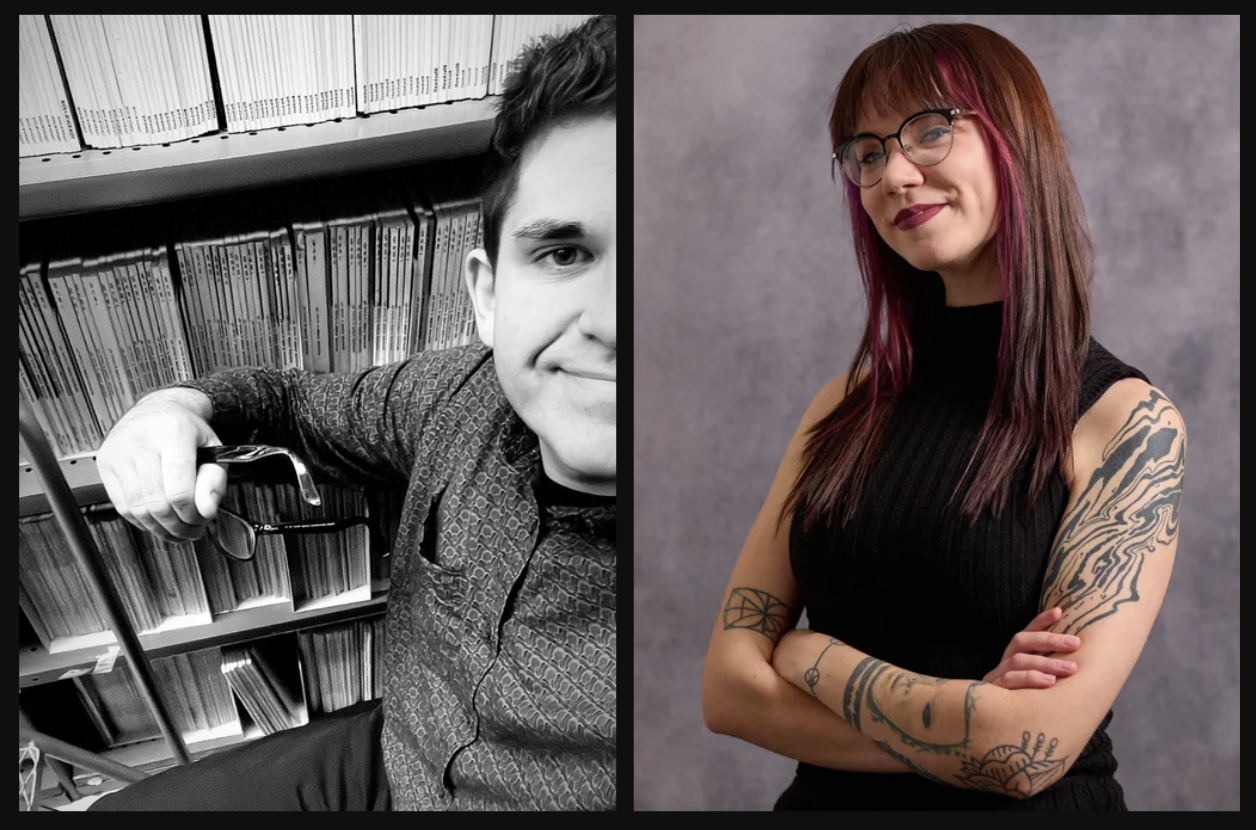
Staff librarians Danny Scopelliti and Taylor Akers
OL: Hello Danny & Taylor and thank you for sharing your insights today. To start, how did you both generally arrive in your respective roles within The Occult Library project?
DS: My own work with the project emerged through my connection with our founder, Daniel Yates. Daniel and I had been brought into contact and connection through a mutual realm of occult interest, and we soon bonded over a shared admiration for library and information work.
Early on, Daniel had recognized my professional work in libraries and had been communicating with me about possibilities for unfolding his project. I was grateful to assist with some of the earliest bibliographic entries, design choices, and ideas. This was an exciting time with many focused, but enjoyable late nights of brainstorming. The rest of the work flowered from there, and we soon began exploring the outlooks of conducting interviews, blogs, and so forth.
TA: My involvement with the Library began with a personal story, as I had to move back to my childhood home in October 2023. It was emotionally taxing to come back to that environment in many ways and in the thralls of doom scrolling one night in a bed slightly too small for me, I stumbled upon Danny’s Instagram post asking for volunteers for the Occult Library. I have always been drawn to the occult in my own ways, and have been leisurely following Danny’s own projects for some time. Upon his call to arms, I contacted the Occult Library.
Having something positive to focus on was huge for my personal stability and mental health. Working with the Library allowed me to keep a strand of my authentic self during that time.
As the life-storm died down, the project continued to grow. I moved back to Pittsburgh and because of my professional work in libraries, I had the pleasure to continue work on the bibliographic entries and collaborate with an awesome group of other volunteers.

Both staff librarians were important to early developments in The Occult Library
OL: You both stand at the intersection of library work and the occult sphere. How did you arrive at this intersection, and how do you feel that the two worlds overlap?
DS: My interests in the occult and librarianship flowed together seamlessly during my earliest teenage years, around the age of 12. I believe that my own divergences — if they can be called that — spurned a gravitation towards heterodox, less-traveled, and obscured roads.
A voracious reader, I soon stumbled amidst the alternative & occult sections of local bookstores. My own aforementioned propensities pulled me towards the worlds that I found there; both as a reflection of how I felt, but also in pursuit of the proverbial gold which I felt could be located therein.
As my father would say, I have always been a librarian prior to any formal setting: I was not only gathering, borrowing, and uncovering new occult books, I was schematically organizing them, and connecting their associations. I felt that they were well worth fostering, and I subsequently had a strong impulse as a kind of caretaker.
Later, these outlooks and interests constellated academically, as I pursued comparative religion studies, and later library & information science, in a formal academic context. I have since worked in libraries of differing stripes for a decade, and remain enmeshed in the occult community.
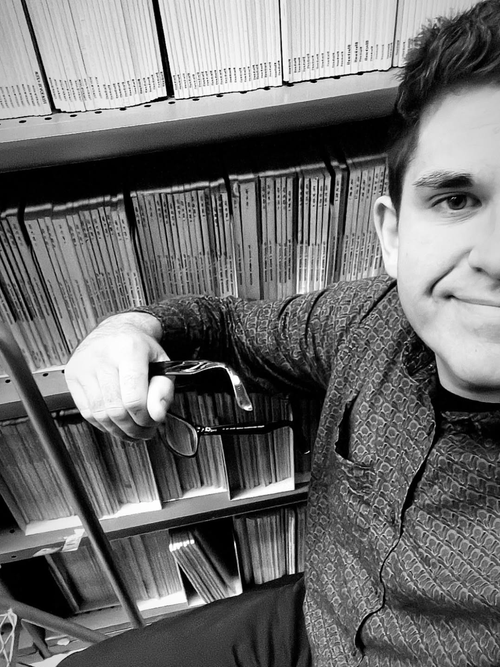
Staff librarian Danny Scopelliti
TA: To be transparent: I am still figuring out where I stand with the occult and what that means.
Looking back, I’ve always had the pull toward the esoteric in my own way. In high school, I had a life changing experience and synchronicity that sent me to Jungian psychology; the gateway reconnecting me to the occult, and introducing me to the library field.
While reading about Jung’s idea of the collective unconscious, I became very interested in learning more about history. I graduated, took a break year, and went to college. I began working in my university’s archives as a part of a work-study. My supervisor, the head archivist, was an older, gentle, religious man. When I inevitably brought up my readings, he sighed with some understanding (and a twinge of exhaustion) and literally said, “Ah, you’re a seeker.” It was like a scene from a movie. At least twice a month, I would find myself in conversation about candle meditation, Christian mysticism, or Buddhism.
From Jung, I read about Gnosticism, which sent me to Hermeticism, which sent me to planetary magick, which sent me to high magick, and so on. When my work-study and undergraduate journey ended early due to COVID, my supervisor recommended going to library school and that was that.
It was like a little candy trail; a connecting line of people and ideas and — of course — books. After all, books are one of the intersections of people and ideas. It’s a conjuring from the inner to the outer; a frozen expression of life, only melted and moved by a human participant.
Being in a place holding all those ideas and energies in books? Connecting those books to their readers? Facilitating the flow and communication between them for the potential of a new expression? Libraries ARE magical.
Also: Giles from the amazing series, “Buffy the Vampire Slayer” may have also been a factor.
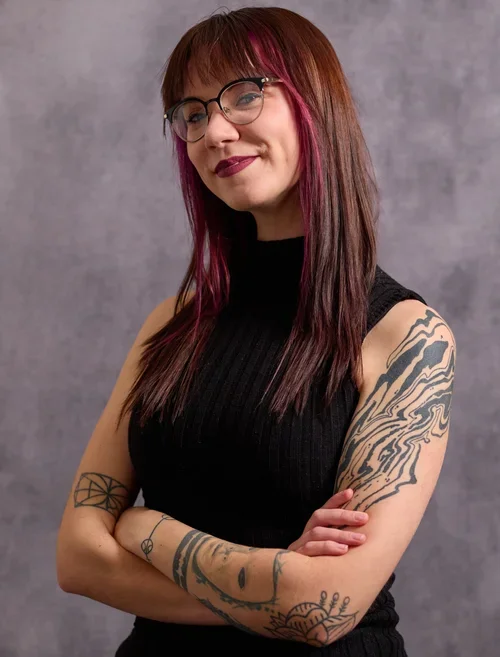
Staff librarian Taylor Akers
OL: Occult traditions have inextricably been tied up with the culture of books and textual transmissions. They are, so often, the very route through which folks become engaged with the occult. What literature had a singular or formative role in shaping your explorations of the occult?
DS: Yes, the occult traditions that one often encounters are deeply entrenched in the culture of the book. Books were really my most direct inroad to the community. I come from a small, semi-rural community, so the literary dimensions of these topics served as a refuge and outlet for me early on.
My earliest explorations were, like many in the United States, centered on solitary forms of neopagan practice. I also found grist for the mill within a broad exploration of world alchemical traditions.
Later, and hungering for a deeper set of visionary dimensions, I began excavating the tracks laid out in works on traditional craft; matters concerned with dreaming pathways, ecstatic art, and subsequent ritual transformations.
However, I will always maintain that such works are found lacking when not supplemented with an examination of global cultures, contexts, and critical comparative lenses. In turn, I find myself prone to reading across texts from differing traditions — even into the traditions found within the hard sciences — in order to contextualize and frame my own path. I would deeply encourage other readers and practitioners to do the same.
TA: Early on in childhood, I was obsessed with ghosts, and one particular book called, Ghost of a Hanged Man by Vivian Vande Velde. It was my first (fictional) introduction to Tarot.
Manly P. Hall’s The Secret Teachings of All Ages was another early one that cast a wide net and gleaning into different traditions and schools.
Obviously, the heavy-hitter was Carl Jung’s Red Book, especially since my engagement with the occult has primarily been through dreams. That book is incredible.
I also loved Damien Echol’s Angels and Archangels: A Magician’s Guide which both introduced me to high magic concepts, and helped me get over the fear from my Catholic upbringing.
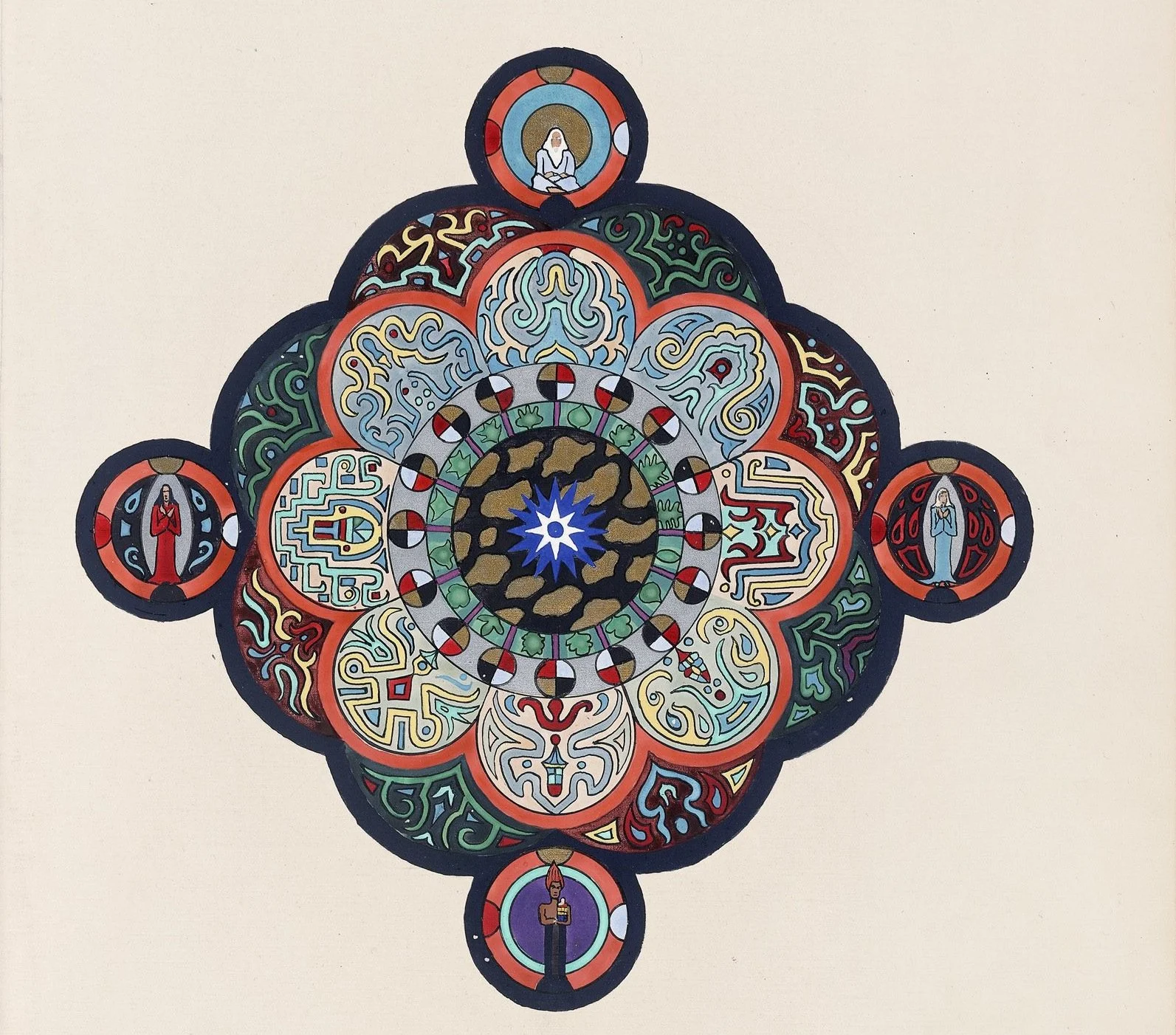
Illustration from C.G. Jung’s Liber Novus (The Red Book)
OL: The Occult Library project is extensive and broad, and you each carry out specific tasks and processes within it. What are some of the challenges and rewards of this?
DS: These days, with our labor fairly well divided up, I have been focusing on blog writing and interviews. This process adds a qualitative element to our work, and it directly engages folks in our occult community.
I find this incredibly fulfilling, and it is all done in the reciprocal spirit of sharing and connection. Librarians are, by nature, very eager to be sharers. In turn, when we engage in a conversation here within the project, we feel that our work is seen and reciprocated for the sake of the greater commmunity.
One challenge I’ve encountered, particularly in our interviews, is the act of “asking the right questions.” Interviews can often be contrived or derivative, and I attempt to break that mold by gently teasing difficult, or thus-far unanswered, questions from our conversation partners. I always inquire, “what has not been asked, and how can I frame it in order to glean an original and compelling answer.”
I find that our interviewees respond well to this challenge in their own right, and it has subsequently made for some incredible kernels of insight.
TA: The primary goal of the bibliographic data project is to reorganize, reformat, and dig into each title’s makeup. Who contributed to the whole work through illustration? How much was this book originally sold for? What are there talismans, incense, and/or additional materials that come with the book that make the work the whole work?
Collectors, practitioners, and general readers have the right to this information. So diving into a book, examining all of its parts, listing its elements while simultaneously making it available to anyone on the internet: that’s the reward. It’s amazing that it’s a possibility.
Of course, there are challenges. Investigating and adding entries can be pretty time consuming and tedious. As new publishers reach out and more editions are released, it can be pretty easy for the work to pile up (which is another reason why we’re so grateful to have more volunteers!).
Additionally, there are the cataloging weeds: how do we organize this information? It’s not like you can find these books in OCLC (Online Computer Library System) — though we have found a few. Typical MARC (Machine-Readable Cataloging) formatting doesn’t meet all of our needs. The Occult Library is international with books rooting back to pre-copyright times.
Original authors and publishers can be obscure, and while I am a librarian, I’m not a cataloging specialist. So early on, with the help of another librarian volunteer, we decided to use a skeletal MARC idea mixed with archival practices.
We created a general template and “data guide,” and looked at the publisher directly. As a collective team, we decided to pull data “as-is” from the publisher across time; looking at current editions, past editions, and trying to add future editions. There can be a lot to juggle, but it's satisfying to see it all come together.
OL: In the context of the greater occult community, do you feel that librarians, library-concerned folks, and information specialists serve their own kind of magical role as stewards of traditions, pathways, and stories?
Librarians serve as stewards of information in the occult community
DS: I have always felt this way, even outside of an occult context. Information and its associated media constitutes the unfurling of literal worlds. To the extent that one grounds any degree of positive value in these worlds, they must be fostered, maintained, and stewarded. The librarian is the one who is called to serve in such a role.
The occult sphere is so deeply entrenched in the culture of texts, writing forms, and books, that it often seems as though this quality is amplified comparatively to other fields. One must acknowledge that books and information media are so often the facilitators and emissaries of occult knowledge. Often, they are the very conduits by which tradition itself is transmitted.
As librarians, we are called to preserve, maintain the health of, and organize these information trackways in order to facilitate the best experiences folks can glean. I believe that this is indeed a magical role: one of the humble steward of occult information.
This must never take on a gatekeeping role, however. To do so would be perilous to the content and the communities. Rather, it invokes the values of appropriate sharing, access, and assistance.
TA: Oh, of course. I think I touched upon this earlier but books are repositories of human expression and, by default, power.
I also just mentioned that I’m not a cataloging librarian. At the moment, I’m a public children’s librarian and in my (albeit biased) opinion, there is no other position where that role is more apparent.
Yes, information specialists and data librarians are gateways in their own right but for me, the direct connection is when I tell a group of kids a fairytale and watch their eyes light up, especially when I engage with the text myself. When I gesture, change my voice, act out the parts and have them engage similarly, the simple reading becomes and adds to the oral storytelling tradition.
New, modern humans can see themselves in the overarching human story, especially now that under represented voices are being included. It’s nothing short of magical.
OL: Have there been any notable library collections dealing with the occult which you’ve admired or looked for inspiration?
DS: I am particularly fond of the collection of the late British artist Robert Lenkiewicz. The artist had amassed a formidable library over his life, rife with unique works on magic and the occult. According to Sotheby’s, his collection included various works from Agrippa, Paracelsus, Basil Valentine, Casaubon, Swedenborg, Fludd — as well as numerous texts on mysticism, Kabbalah, demonology, etc.
Through his expressions, Lenkiewicz expressed the magical & prophylactic function of books. In the 1996 documentary, Demon or Delight, he can be seen imbibing the smell of an old book. In this scene, Lenkiewicz says:
An interesting example, probably 17th century, is this item — which was carried around probably over the shoulder by, possibly, some kind of Berber priest in the Middle East. Its function was prophylactic; it had a kind of magical function. He would go around to different firesides in the desert, wandering about near the monasteries where he lived, and he would sit down there and talk and discuss some problems or difficulties — some of these tied up in the cult of Maryology, the fanatical belief systems about magic in relation to the Holy Virgin. And it’s interesting, this, because here it’s not just tactile, but you can actually… smell… quite literally… the fire, almost as if it had been burnt. And in a way, it has: It’s been burnt with time.
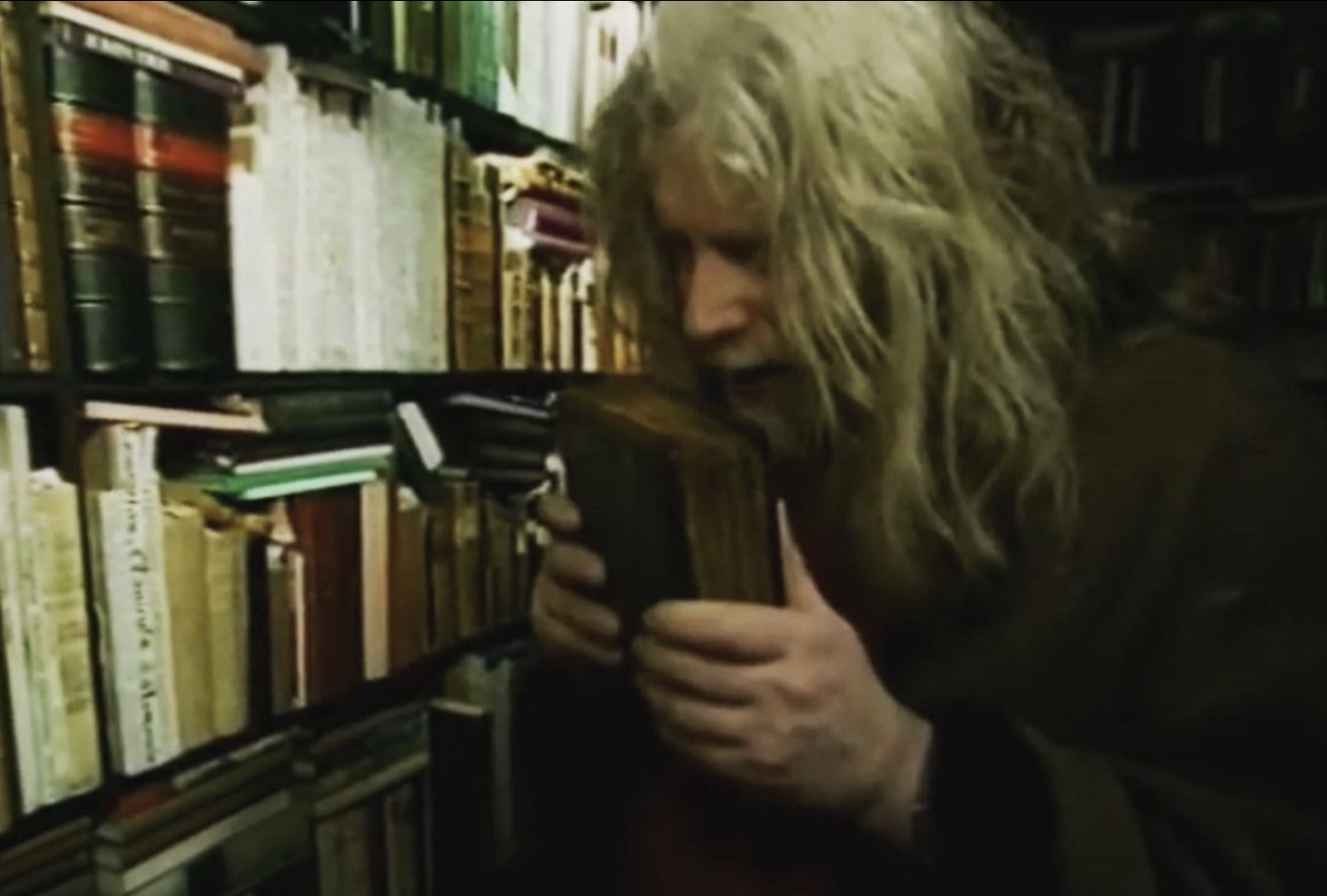
Robert Lenkiewicz is seen here imbibing a particular smell from a book in his prodigious library in the 1996 documentary Demon or Delight.
TA: I had the immense privilege to go to Amsterdam this October of 2025, and toured the Bibliotheca Philosophica Hermetica (BPH), or, The Ritman Library. It’s a Dutch library founded in 1957 by Joost RItman and it was just… awe-inspiring. I literally cried. Just in the public display cases were the Arbatel De magia veterum (1686), Agrippa’s De occulta philosophia (1533), Spinoza’s Tracatus theologica-politicus (1670), and the Clavicula Salomonis. There’s a private library as well, but it was a little expensive to see it and I didn’t have the time. I will definitely be back though!
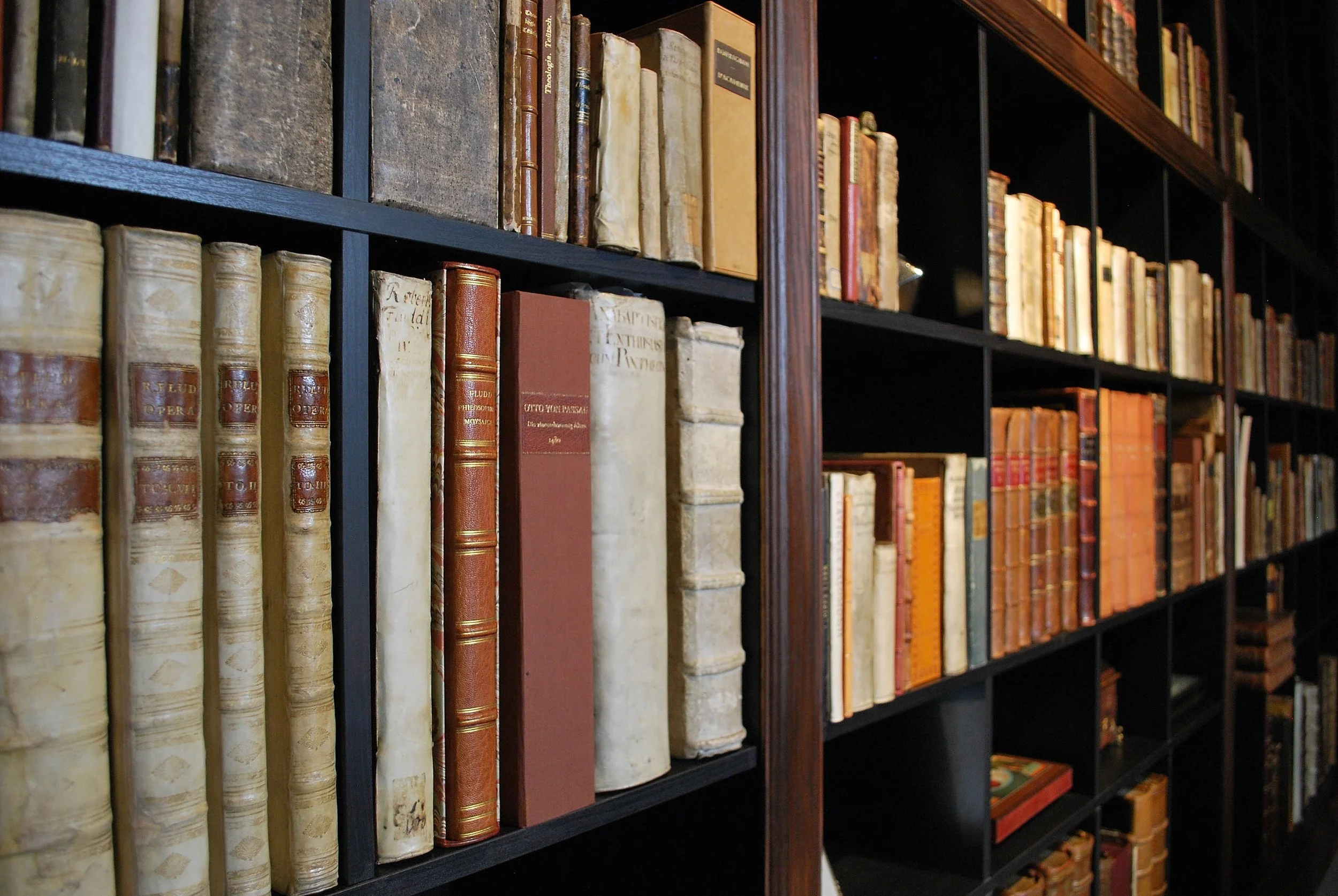
Rare books in the BPH collection, featuring Robert Fludd's collective works on the left. Image via PragueGnosis.

OL: What kind of visions, goals, or outcomes do you foresee emerging within the Occult Library project as we reach our second year this January?
DS: For me, I look forward to widening our interview conversations, and expanding the scope of who we chat with. I also look forward to continued work on the occult explorations taking place in our Curio section.
However, in all, I simply enjoy ruminating on our goal of continually serving as a space to bridge and enhance the community which has offered us so much.
TA: Can I just say that two years is both really long and really short? Time isn’t real.
Well first of all and for my part of the project, I really, truly, desperately have a goal of getting 70% of the bibliographic entries done. If 5 more volunteers joined our team long-term, that would also be cool.
Third, I imagine tagging and categorizing occult traditions together for a more advanced search and research flow. Imagine being interested in Witchcraft, going to our search, searching by tagged “WITCHCRAFT” and boom! Here are the titles we archived that are under that tag! Here’s Treading the Mill by Nigel Pearson! It would be an amazing tool and one that I think is very possible to implement.
OL: Finally, what has been the most fulfilling aspect of this project for you?
DS: I find incredible fulfillment from hearing of folks who uncovered something new, felt invited into this community, or had a need met. I feel that the conversations and contacts that the project has offered me are particularly important: they serve as means of expanding my own inner library, and learning more about the experiences and qualities that mark life in the community.
TA: I’ll end with how I began and say that the most fulfilling aspect of this project for me has been its grounding effect.
Life is always a dance of shifting energies and working with a library collection aimed at recording the books that teach you about those shifting energies removes the mortal brain fog. I have the space, time, and purpose to sit with these books, sit in that part of myself, talk with others all around the world who also feel that same part in themselves and together, we can work on a thing that we are all passionate about. I truly feel rooted here.
OL: Taylor and Danny, thank you so much for your efforts, and for taking the time sit down today to discuss our work!
TA: Thank you so much!
DS: Thank you for the conversation!