
Cyprianus, Key to Hell
There is a long tradition of grimoires being black books, or dark. This manuscript is not part of that tradition. Thee original manuscript was bound in scarlet velvet This facsimile reprint is likewise bound in red velvet.
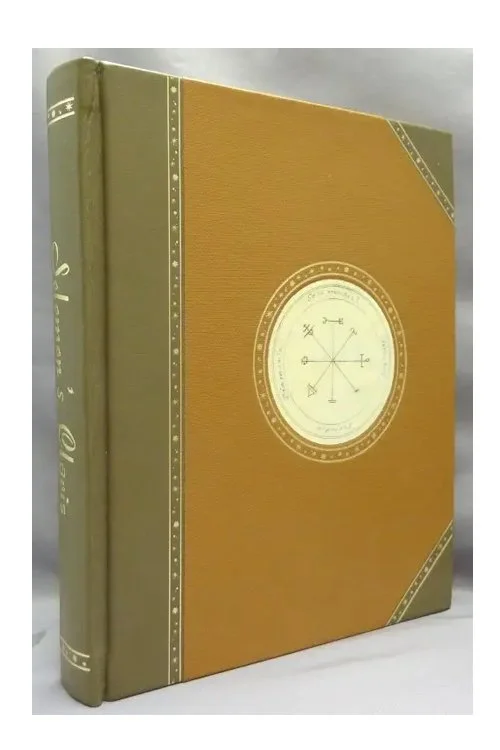
Solomon’s Clavis
Sibly wrote the original manuscript c.1800, translating its core from French but also writing many additions including a preface and the talisman designs. The text is entirely different from the Key of Solomon as translated and published by McGregor Mathers.

Grimoire to Conjure a Spirit of a Place
The text is remarkable. It seems to describe a ritual that the writer carried out. Protection is sought from a demonic Trinity before Christian powers are used to evoke an infernal spirit, specially associated with the place of the working, into a piglet that is led into a magic circle where it is slain.

Conjuration and an Excellent Discourse of the Nature and Substance of Devils and Spirits
Provides a great deal of general information as to the magical regalia and practices of the conjurors of spirits. Some aspects seem quite modern, for instance a magic circle need only be imagined to be effective. Some of the regalia, such as snakeskin belts and so forth, is rather reminiscent of shamanism.

The Grimoire of Pope Honorius
This is a facsimile of the manuscript belonging to F.G Irwin who was a member of Societas Rosicruciana in Anglia, The Society of Eight, the Fratres Lucis and the Golden Dawn. He was an important figure in the 19th Century British occult milieu.


On the Tarot - Le Monde Primitif
Referring to it as the Book of Destiny, Antoine Court de Gebelin published the first documented essays on the Tarot in his multi-volume French encyclopedia Le Monde Primitif in 1787.

Monas Heiroglyphica
Elizabethan Magus John Dee is an intriguing figure in the history of ideas and the Hermetic Tradition. The Monas Hieroglyphica represents one of his most important works and expounds upon his monadic glyph in a series of 24 theorems in terms of mathematics, magic, kabbalah and anagogy.

Mytho-Hermetic Dictionary
Written 1758 the Mytho-Hermetic Dictionary defines the most obscure of terms, substances and concepts employed by the enigmatic authors of the alchemical texts. Its entries unlock the Hermetic mysteries veiled by the motifs, allegories and symbols of the classical myths as well as making clear what substances are implied by the terms expressed by the Language of the Birds.

Testament of Solomon
Solomon, son of David is famous as being a master of magic and wisdom in many texts of Western Esotericism. His fame extends through Judiasm, Christianity and Islam. The Solomonic grimoire cycle is among the most cited and most used of magical texts and the Testament of Solomon provides a background for one of Solomon’s potent acts, the building of his temple.

Petit Albert
The ‘Little Albert’ is a grimoire and book of secrets first published in France in 1700s. The text ranks as one of the most infamous books in the grimoire corpus, though much of its infamy stems from the 18th century hucksters who populated Rural Europe with copies of their merchandise.

Triangular Book of St. Germain
The Triangular Book of St. Germain is unique in the history of occult manuscripts. Supposed to belong to St. Germain the Grimoire past through the hands of many prominent occultists through the centuries.

Cabala
CABALA: SPIEGEL DER KUNST VND NATUR was first published precisely four hundred years ago in the Free Imperial City of Augsburg, located in the Holy Roman Empire. The first edition was printed by Johann Schultes Sr., and published by the enigmatic Tyrolean, Stephan Michelspacher. CABALA remains one of the most fascinating, beautiful and problematic alchemical texts of the early seventeenth century.

Zoroaster’s Telescope
Zoroaster’s Telescope is a wonderfully strange book of oracle magic. Written in 1796 by André-Robert Andrea de Nerciat, a French author of Libertine genre, the text later appeared in a collection of German folk literature compiled by Johann Scheible from which this English translation was made.

Heiroglyphical Key
Nicholas Flamel’s Hieroglyphical Key is offered with two additional texts; Summary of Philosophy and his, Testament. The quality of the emblematic engravings in the Ouroboros Press edition are exquisite and are reproduced in crisp offset printing.

Daemonologie
Readers familiar with the King James Bible will find this book on Demonology and Witchcraft of significant interest. The Daemonologie of King James came about due to the involvement of James VI of Scotland in the North Berwick witch trials.

The Rosicrucian Manifestos
Early in seventeenth century Germany two anonymous manuscripts were in circulation which would cause a stir in intellectual and spiritual communities in Europe with calls for reformation and a focus on the Hermetic-Cabalist tradition.

Theatrum Chemicum Britannicum
The Theatrum Chemicum Britannicum is a major collection of English alchemical texts which encapsulate the arcana of the Magnum Opus in poetic form. Originally gathered from several rare medieval manuscripts by Elias Ashmole, the text represents the largest collection of verse treating of the production of the Philosopher’s Stone to be brought together in one volume.

Jocus Severus
Jocus Severus was originally published in 1617 by Count Michael Maierand is here rendered into the English tongue from the Latin text by the remarkably able translator Darius Klein.