In Conversation with Jonathan Davies of Midian Books
Jonathan Davies runs best-loved bookseller Midian Books, based in Derbyshire in the United Kingdom. “Established in 1991, Midian is an online store showcasing books, art and ephemera from the subcultural strands of the 20th and 21st century; esoterica, occulture, surrealism, erotica, underground cinema, subversive literature, outsider art, and the outré."
Jonathan founded Midian Books by utilizing redundancy money from his work with a publishing house to accrue a number of occult editions. Jonathan self-produced a number of cataligues that are unique in their own right. He notes, “Unfamiliar with the book dealing business, I simply copied the style and layout of book catalogues I’d collected. Consequently, I remained relatively anonymous for the first few years.”
Many of these catalog covers will be featured throughout this conversation.
Subsequent to the early 1990s, Midian Books has grown to emerge as a cornerstone of the occult bookselling sphere. Today, we speak in conversation with Jonathan to explore origins, art, and the occult.
OL: Hello Jonathan, thank you for taking the time to speak with us today about your work. To begin, Midian Books was founded in 1991. This was an exciting time in the U.K. both counter-culturally, and from an occult perspective. Could you tell us a bit about the lead-up to Midian’s founding, as well as the atmosphere for you personally during that period?
JD: I was pretty introverted as a teen/young man. I had always been interested in mythology, the occult and the counter-culture scene but it was strictly a solo pursuit, none of my (few) friends were in the slightest bit interested. But through various fanzines (pre-internet days kids!) I managed to find like minded people. I was a university drop-out and unemployed for a time but landed my first real (and dream) job working as a paste-up guy for Thorsons Publishers.
They owned several imprints but most significantly Aquarian Press, who published books on The Golden Dawn, Crowley, Tarot and much more. I had a great two years handling all this rare material, preparing images for print, etc. Then, Thorsons got bought out by Rupert Murdoch/Harper Collins and all us low level grunts were made redundant. BUT, as they were moving headquarters they sold off the entire archive (having at least 2 or 3 copies of every book they ever published) so with my redundancy money I bought as many books as I could afford, and that’s how Midian started.
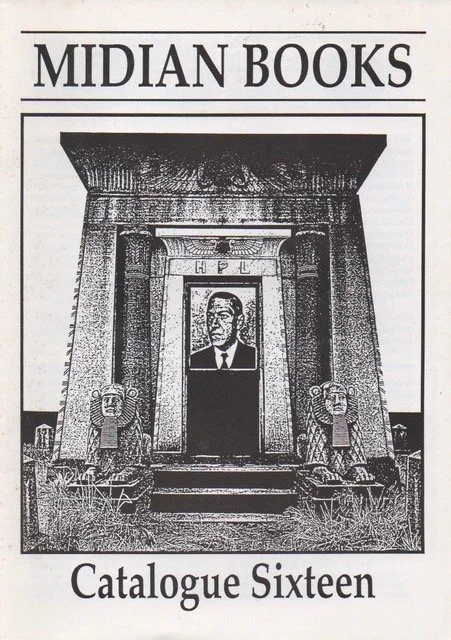
Midian Catalogue 16, featuring art from Peter Smith of the Esoteric Order of Dagon.
OL: In the days prior to the massive flourishing of social media and immediate web access, what was your approach to amplifying your work and finding materials to buy or sell? In what way did you rely on printed short lists, catalogs, and brochures, festival booths, classified advertisements, and word of mouth?
JD: I was pretty naive to be honest and for the first few years I struggled to make an impact. I had collected books myself for a while so I literally just copied the style and look of book seller catalogues I liked (Deja Vu books in Brighton being one). I advertised in The Book and Magazine Collector (where you had to pay per line of listing) and got free adverts in various fanzines (Grim Humour, Your Worst Fears Confirmed, and others). The first real breakthrough came when, through a mutual friend (Stefan Jaworzyn of Skullflower/Shock Records) I managed to commission a catalogue cover from the mighty Savage Pencil (an automatic portrait of Aleister Crowley). I then had a stall at the Pushing Against the Wire festival in Northampton (noise music and counter-culture) and got a load of sign-ups and traction there.
Shortly after that I had another boost when I ‘bought’ Cease To Exist. This was the mail-order division of counter-culture publishers Creation Books. The editor at Creation (the notorious James Williamson) wanted to concentrate on just the publishing so one weekend I went down to London, paid a lump sum of money and came back with distributor accounts, a big mailing list of customers and as many books as I could carry (Creation, RE/Search, Feral House etc.). I ran the Cease To Exist catalogues for nearly a decade before Amazon came along and made it financially impossible, but all that counter-culture got absorbed into Midian.
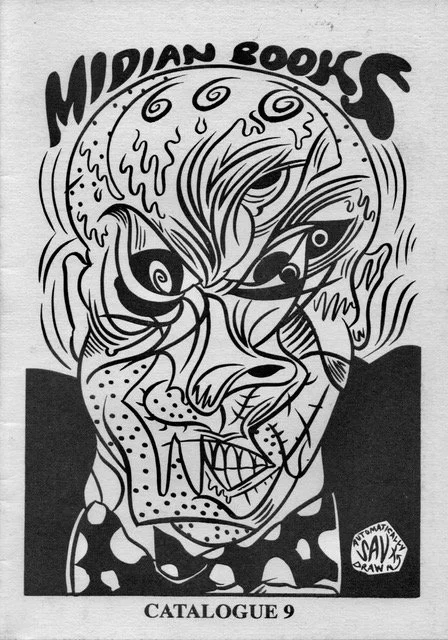
Midian Catalogue 9, with art from Savage Pencil. A watershed moment for Midian’s visibility.
OL: While Midian Books does have a focus on the occult, you also place heavy emphasis on several countercultural and subcultural milieus such as “esoterica, occulture, surrealism, erotica, underground cinema, subversive literature, outsider art, and the outré.” While these constitute a broad range of topics, they are certainly woven together in a cohesive and meaningful way. Your own work is reflective of this. What do you find the most pertinent connecting threads between these areas to be? Is it a commonality that concerns the peripheral, subversive, or marginalized?
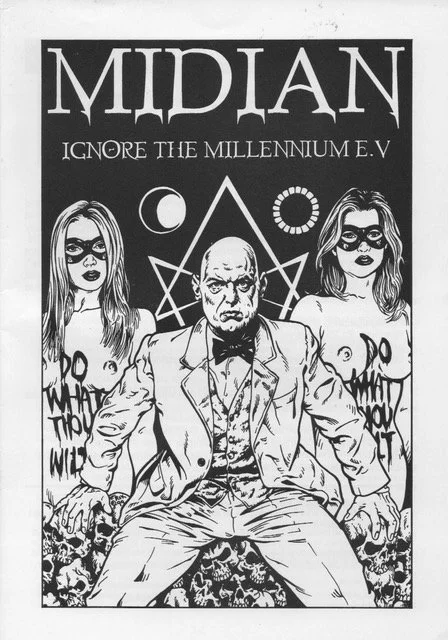
Midian Catalogue 28, a response to the year 2000. It features cover art by comic artist Rik Rawling.
JD: I can only say that I feel everything is connected. You cannot claim to be an occultist and NOT be interested in or be influenced by art, by poetry, literature, (un)popular culture or eroticism. I am always wary of magicians whose libraries consist solely of books on magic (and fucking Terry Pratchett novels…) I’m lucky enough to count the Scarlets (Peter and Alkistis) as friends, visiting them and seeing the sheer breadth and diversity of their library is breathtaking. I implore you magic kids; read a banned book, go see a subversive film, have actual sex, you and your magic will be better for it.
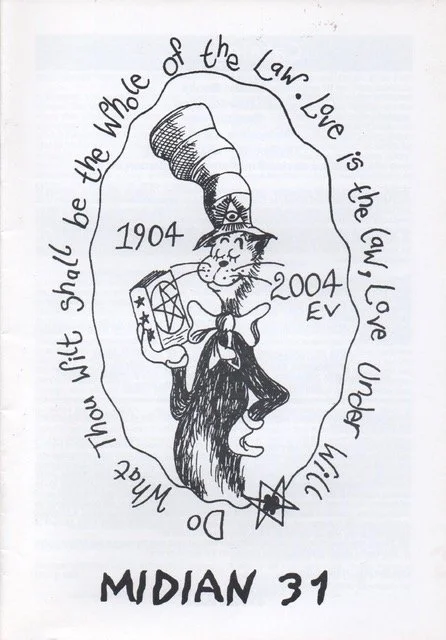
Midian Catalogue 31 displays cover art by Jonathan’s late partner Victoria Musson, and it celebrates both the 100th anniversary of the reception of The Book of the Law, and Dr. Seuss.
OL: This year marks 35 years since the founding of Midian in 1991. In a constantly shifting landscape, this longevity is an impressive feat. What are some of the smaller changes and seismic shifts you’ve experienced in this world since you began? Do you feel that the unique nature of your materials lends a kind of persistence?
JD: Obviously the biggest shift was the dawn of the internet. I issued my last printed catalogues in the early 2000s. It became ridiculously expensive to print and mail out 400-500 catalogues on a bi-monthly basis so I stopped. But it then became effectively an exercise in building back an audience. Some had access, others didn’t, it took a few years to rebuild.
The internet was also a great leveller. It became easier and easier for people to find rare books themselves rather than waiting for a catalogue through the mail so I had to find new avenues and new areas of interest. Midian became much more ‘curated’ during this time (though I dislike that term). The advent of ‘Talismanic’ publishers certainly helped, and I managed to build up relationships with many of them. At the moment I am just enjoying discovering new things and then sharing them. If I can find one new person (alive or dead) and a body of work I knew nothing about, that really tickles my pickle.
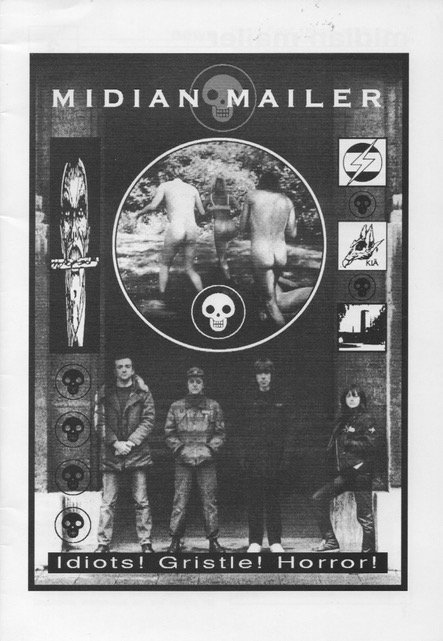
Midian Mailer 1 was an attempt to combine book listings with interviews and reviews. This issue covered Throbbing Gristle, and Lars Von Triers’ films The Idiots, and Lord Horror.
OL: The current design and identity of your site is unique and accessible. For this, you carried out work with Greek-born artist Eleni Avraam. Eleni's art centers heavily on occult & esoteric expressions and is very compelling. Could you tell us more about your association with Eleni, and speak about the importance of collaborating with artists in the community?
JD: After I got Savage Pencil to do that first cover, I made it a goal to find artists that I liked and commission them for artwork. It was always a collaborative process, but it kind of came to a halt when I stopped the physical catalogues and for years I relied on my own attempts at design. I discovered Eleni through her art during the Covid lockdown. We corresponded and bonded (over a mutual love of Jesus Franco films among others!), and the working relationship just clicked.
Eleni has been responsible for the look of Midian (on the website, social media, and emails) for the past few years now and I couldn’t be happier. I am especially happy with our digital “Short Lists” (online catalogues featuring items on a specific topic), where Eleni takes my attempts at layout and smoothes the rough Ashlar. I also like her art because it is alive and vibrant. I’ve been through my period of black and white occultism, dark images and scary fonts, now I want a bit of colour.

The above image intimates marbled endpapers, and is used as the backdrop for the Eleni Avraam-designed Midian website.
OL: Looking back on your time in this field, what would you identify as the greatest rewards and most pressing challenges of your work? Perhaps you’ve helped spur on an eager newcomer, or helped place a rare collection safely in the hands of a worthy owner?
JD: Greatest rewards are definitely to be had with the placing of items in the hands of people who really appreciate them. After years of dealing you get a sense of who wants an item for themselves and who is looking at the resale market. I’ve become fairly ambivalent about book scalping. Obviously as a dealer I’m looking to buy at a good price and sell at a profit. If someone comes along, buys that book from me then sticks it on ebay for 3 times the price, good luck to them, there will always be another copy in time for a much more reasonable price.
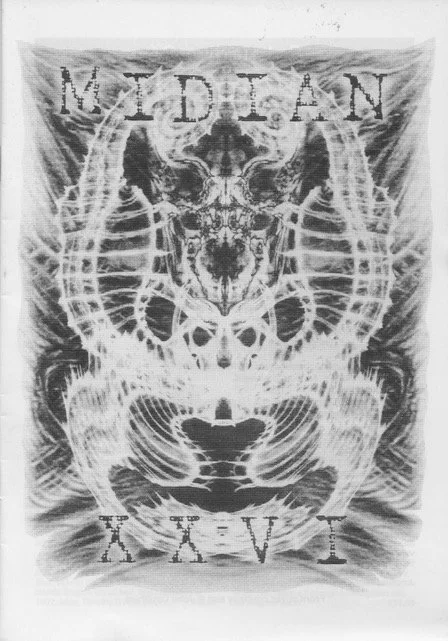
Midian Catalog 26 displays a cover by John Coulthart, taken from his designs for a Lovecraftian collaboration with Alan Moore that got ‘lost’ in a taxi. Rewritten segments appeared in The Haunter of the Dark.
OL: Lastly, over the years you have surely encountered a number of books and artworks that stood above the rest. What were some of these works, and what was the experience like being able to steward them?
JD: Lots of stories! Fairly early on the comic book writer Alan Moore was a regular customer and it was amazing to get a phone call and hear that deep gruff voice asking my opinion on certain books. My first big sale to him was a hand written letter by Aleister Crowley containing “The Word of the Equinox”, which he still has framed in his office.
I spent an hour on the phone to one guy who was very interested in The Son of Sam killings, The Ultimate Evil book etc. I asked for his name when he finally placed an order and it was Jeremy Beadle! Excitedly, I called another dealer and he was like “oh yeah him, did he pester you for true crime stuff?”
There is also the joy of finding treasure in unexpected places. I once found a first edition “Book of the Law” by Crowley in a box of legal pamphlets at a book fair. Paying my £5 I asked the stall holder if he had any more books on the occult, he though I said “the Courts” and directed me to more legal stuff!
OL: Jonathan, thank you so much for speaking with us today, and sharing some insights into the history and work of Midian Books. We look forward to speaking down the road!
JD: A pleasure. Obviously I will plug my site www.midianbooks.com. You can find Eleni’s work at www.eleniavraam.com. Upcoming Short Lists include one on Witchcraft magazines of the 1970s, a large archive of material from The Process Church of the Final Judgment, plus more on Coum Transmissions, Thee Temple Ov Psychick Youth, and body modification.
Midian Books can also be found on Instagram via @midianbooks.